
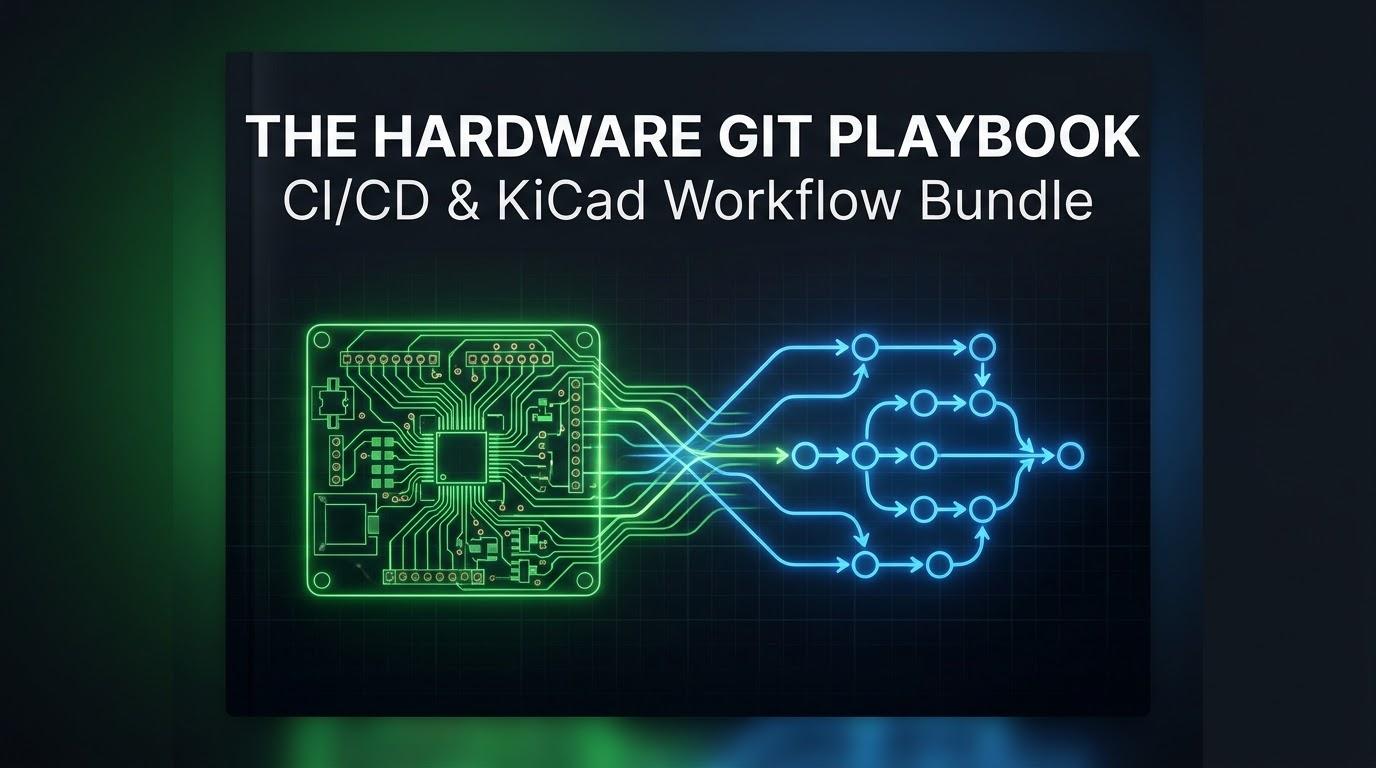
The Hardware Git Playbook & Modular KiCad Project Template
Stop keeping daily .zip backups. Stop letting Git corrupt your PCB layouts. Master parallel hardware collaboration without paying Altium's $3,000/year subscription ransom.
The Nightmare We Live in Hardware Version Control
Git was built for software developers writing line-by-line text. It was never designed for printed circuit boards.
When you try to branch, collaborate, or merge a KiCad layout file, Git treats it like standard text. The result? XML and parenthesis-based S-expression spaghetti, scrambled net UUIDs, and a completely corrupted, un-openable .kicad_pcb layout file.
To avoid this, hardware designers fall back on painful workarounds:
The "Daily ZIP" Habit: Manually backing up the project folder every night into a ZIP archive named project_v2_final_hand-soldered_v3_FIXED.zip.
The Isolated Branch Trap: Treating branches as completely separate, non-mergeable projects to prevent data loss.
The subscription ransom: Getting locked into proprietary clouds like Altium 365, only to be held ransom for $3,000 a year just to access your own historical files if your subscription lapses.
There is a better way. You don’t need a $3,000 software suite to design, track, and collaborate on hardware. You just need a bulletproof, hardware-native Git workflow.
What is The Hardware Git Playbook?
This is a comprehensive, step-by-step workflow guide and pre-configured project template package designed to make KiCad and Git work together seamlessly. Developed using proven industry and community workarounds, this playbook outlines a structural approach to version control that protects your spatial layouts from corruption, enables clean parallel collaboration, and automates your entire release cycle.
What’s Included in the Deliverable Bundle:
📂 1. Standardized CAD Directory & .gitignore Config
An opinionated, production-ready directory structure that isolates local editor states, footprint caches, and auto-saves from your active repository.
A pre-configured .gitignore file tailored specifically for KiCad to prevent local user configurations from polluting the commit history.
Instructions on how to securely track custom libraries (.pretty and .kicad_sym directories) so your team is always working with verified, in-sync components.
🔀 2. The Hierarchical Sub-Sheet Framework
How to split your schematic architecture into self-contained sub-circuit files (e.g., isolating power conditioning from MCU signals).
By isolating design boundaries, different engineers can edit separate sheets simultaneously without ever triggering a schematic merge conflict.
Step-by-step instructions on clean re-annotation and copy-pasting schematic blocks between KiCad instances without scrambling component UUIDs.
🛠️ 3. GUI-Based Visual Diff & Layout Merge Protocol
Because text-based diffs of layout files are completely uninterpretable, you will learn the exact steps to wire up visual diffing tools like KiCad-Diff or Meld.
Generate PNG layer overlays to visually inspect track routing, ground planes, and component shifts side-by-side before you ever click "Merge".
The "Relay Baton" workflow: a disciplined protocol for layout changes, demonstrating how to append pre-routed sub-layouts and manually stitch ground plane return paths to prevent electromagnetic interference (EMI).
🤖 4. Pre-Configured GitHub Actions CI/CD Script
An automated release pipeline YAML script for your repository.
Every time you push a tag release (e.g., v1.0.0), the pipeline automatically compiles and exports verified Gerber files, drill files, BOMs, and schematic PDFs.
Built-in pre-fab checks to verify mechanical clearances (such as a 1.5mm keep-out radius around mounting fasteners to prevent screw-head short-circuits) and electrical trace configurations before your design is sent to fabrication.
Who Is This Product For?
Solopreneurs & Indie Hardware Founders: Who are building custom hardware products, managing everything alone, and cannot afford to lose days of routing progress to a corrupted layout file.
Embedded Systems Generalists: Software engineers who have inherited PCB design responsibilities and want their hardware workflow to match the clean, automated branching standards of their software pipelines.
Small HW Engineering Teams: Who need to collaborate on dense, complex layouts without stepping on each other's toes or locking themselves into expensive, closed-source ecosystems.
Stop risking your physical board runs. Grab your copy of the Hardware Git Playbook today and bring software-grade version control to your hardware workbench!
No reviews yet. Purchase to leave a review.